
Most outbound delays at a warehouse are not caused by the truck. They happen because the driver arrives and the freight is not quite ready: the bill of lading has the wrong pallet count, a label still shows last month’s consignee, or nobody told the dock which carrier was collecting which pallets. The driver waits, the next stop slips and the shipment may miss its line-haul.
This checklist is for shippers, importers and freight brokers who keep stock at a Miami-area warehouse for pallet storage, cross-docking or warehouse overflow and need it collected by an LTL carrier or a full truckload. It covers what to send the warehouse, what the paperwork must show and what happens at the dock door. Carrier rules quoted below are examples from published carrier guides; your carrier’s terms may differ. It is general operational guidance, not legal or contractual advice.
The short answer
Send the warehouse a written pickup release before the carrier is booked, listing the pallets, the carrier, the pickup date and the reference the driver will quote. Make sure the bill of lading matches the freight exactly: number of handling units, pieces, description, weight and dimensions. Label every pallet on the sides a forklift approaches, numbered “1 of 4”, “2 of 4” and so on. Then the warehouse can stage the freight by carrier and pickup time, so the driver loads, counts, signs and leaves.
What “ready for pickup” means
| Item | What to prepare | Why it matters |
|---|---|---|
| Pickup release | Your reference, which pallets or SKUs, carrier, date and pickup window | The dock picks and stages the right freight for the right driver |
| Carrier booking | LTL pickup request or truckload appointment, made with accurate counts and weights | The carrier sends suitable equipment at a time the dock is open |
| Bill of lading | Handling units, pieces, description, NMFC item and class for LTL, weight, dimensions | It is the receipt for the freight and the basis of the carrier’s invoice |
| Pallet build | Stable, wrapped or strapped, with no overhang and nothing loose on top | Unstable pallets can be refused, re-worked or damaged in transit |
| Labels | Consignee, reference, PRO number where used, “X of Y” on each pallet; old labels removed | Pallets stay together through carrier terminals and are easy to count |
| Contact | A named person who can answer the dock or driver if something does not match | Questions are resolved while the truck is at the door, not afterwards |
Booking the pickup
Book the carrier only after the warehouse has confirmed it can have the freight ready. A pickup booked for freight that is still being received, or that is stored behind other stock, is a common source of wasted trips.
- LTL pickups. LTL carriers collect on a route, so the pickup is usually a window rather than an exact time. ABF Freight’s packaging guide, for example, lists what a pickup request needs: pickup and delivery addresses, the requested pickup date and time and the dock close time, contact names, the commodity and special handling needs, and the number of handling units with exact dimensions and weight. Give the carrier the warehouse’s receiving hours as the dock close time, not your office hours.
- Truckload pickups. A dedicated truck normally has a fixed loading appointment. Agree with the warehouse whether the trailer will be loaded live while the driver waits or dropped and collected later, and do not assume either is available without asking.
- Brokers. If a broker books the carrier, make sure the broker passes the warehouse’s reference and loading hours to the carrier, and tells the warehouse the carrier’s name and pickup number.
For inbound deliveries the same logic applies in reverse; see LTL vs FTL inbound deliveries for how the two modes differ at the receiving dock.
The bill of lading
The bill of lading (BOL) is the carrier’s receipt for your freight. Under 49 CFR 373.101, a for-hire motor carrier must issue a receipt or bill of lading showing the consignor and consignee, origin and destination, the number of packages, a description of the freight and, where it affects the rating, the weight, volume or measurement. In practice, the handover at the dock is quickest when the BOL you send matches what is physically staged.
- Handling units and pieces. State both. Twenty cartons stretch-wrapped onto one pallet are one handling unit and twenty pieces. If the warehouse consolidates or splits pallets for you, update the BOL before the pickup.
- Dimensions and weight. NMFTA advises shippers to record the dimensions of each handling unit on the bill of lading, because more items are now classified by density following the 2025 National Motor Freight Classification changes. Use the actual palletised weight, including the pallet.
- Freight class. Carriers handle missing information differently. XPO’s packaging guide, for example, states that BOLs missing the NMFC class are automatically billed at class 100 unless an inspection is performed. Check your carrier’s rules rather than leaving the field blank.
- Hazardous materials. If any item is a regulated hazardous material, the shipping paper must follow 49 CFR Part 172, Subpart C, which requires, for example, hazardous entries to be listed first, shown in a contrasting colour or marked with an “X” in an “HM” column. Tell the warehouse before the freight arrives, not on the day of pickup.
Pallet build and labels
A pallet that left the warehouse stable is far less likely to arrive damaged. OSHA’s general materials-handling standard, 29 CFR 1910.176, requires stored material stacked in tiers to be “stacked, blocked, interlocked and limited in height” so that it is stable and secure against sliding or collapse. The same principles help freight survive a trailer and a carrier terminal.
- Stack cartons tightly within the pallet footprint, wrap from the bottom up and strap heavy items to the pallet.
- Label each pallet on the faces a forklift approaches. ABF’s guide asks for PRO and address labels on all fork-entry faces, every handling piece numbered “X of X”, and freight over 96 inches long labelled at or near both ends.
- Remove or cover old labels. FedEx Freight’s packing guidance gives the same instruction and suggests placing any documents in an external shipping pouch.
- Mark “do not stack” or similar handling labels only where they are true, and put the same instruction on the BOL.
If pallets need to be rebuilt, re-wrapped or relabelled before they can go, ask the warehouse first. It is a separate task from staging and should be agreed in the scope, not discovered at the dock door.
Staging freight at the dock
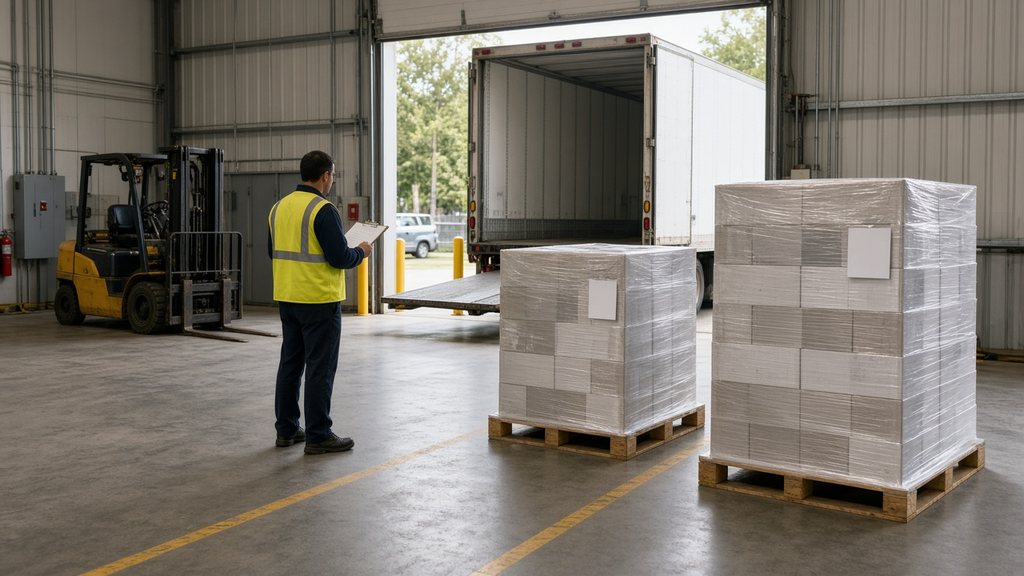
Staging means bringing the released pallets from storage to a marked area near the dock door shortly before pickup, grouped so the driver loads only what is theirs. A clear stage normally shows:
- pallets grouped by carrier and pickup, not by SKU;
- a stage sheet or tag with the carrier name, the reference or PRO number and the pallet count;
- labels facing the aisle, so the count can be checked without moving pallets;
- clear walkways and forklift aisles. OSHA 1910.176 also requires safe clearances at loading docks and aisles kept free of obstructions that could create a hazard, so a good stage is planned rather than spread across the floor.
When several carriers collect on the same day, freight is staged in pickup order rather than all at once first thing in the morning. Our freight staging service describes how 3PL Prime organises outbound loads by carrier and pickup window.
Handover: count, signature and securement
At the door, the driver and the dock team count the pallets against the BOL, note any visible damage and sign. Agree in advance what you want recorded, for example a photograph of the staged pallets or of the loaded trailer, and who should be told if the count does not match.
- Before loading starts. OSHA’s dockboard standard, 29 CFR 1910.26, requires measures such as wheel chocks to stop the trailer moving while employees are on the dockboard. A driver may be asked to wait in a set area while the trailer is loaded.
- Securing the load. Federal cargo securement rules in 49 CFR 393.100 require cargo to be secured so it does not shift in a way that affects the vehicle’s stability. FMCSA guidance states that, unless hazardous materials are involved, it is the responsibility of the motor carrier and the driver to ensure cargo is properly loaded and secured. The warehouse loads the pallets; the driver should check the load and use load bars or straps as needed before leaving.
- Truckloads loaded without a driver count. If a trailer is loaded and sealed while the driver is elsewhere, agree how the count is recorded, and write the seal number on the BOL.
Fitting pickups into warehouse hours
3PL Prime in Medley operates Monday to Friday, 8:00 AM–4:00 PM, and is closed at weekends. Carriers should arrive with enough time to load before closing. LTL carriers often collect in the afternoon after their deliveries, so a pickup requested for late on a Friday that is missed will normally wait until the following week. If the freight must move on a particular day, say so when you book and allow a margin.
If a carrier is running late, ask the carrier or broker to call ahead so the pickup can be moved, rather than the truck arriving after the dock has closed.
Hypothetical example: three pickups, one afternoon
Hypothetical example with invented figures, not a customer case. An importer stores palletised goods at a Medley warehouse and needs nine pallets shipped on a Wednesday.
- Two pallets go by LTL carrier A to a retailer in Orlando.
- Three pallets go by LTL carrier B to a distributor in Atlanta.
- Four pallets join a truckload booked by a broker for a 2:00 PM loading appointment.
Without preparation: the importer emails “please ship 9 pallets Wednesday”. Both LTL drivers arrive at 1:30 PM; the dock has to work out which pallets belong to which carrier, and carrier B’s BOL says two pallets instead of three. One driver leaves without the freight.
With preparation: on Monday the importer sends one release per shipment, with references, pallet IDs, carriers, pickup numbers and BOLs. The dock stages the two-pallet and three-pallet groups in separate marked lanes with “1 of 2” and “1 of 3” labels, and brings the four truckload pallets to the door shortly before 2:00 PM. Each driver loads, counts against a matching BOL and signs.
The figures are invented for illustration. They show why one release per shipment and a matching BOL make the dock’s job simpler, not how long any particular pickup will take.
A pickup release you can copy
- Your company name and release or order reference:
- Pallets or SKUs to release, with quantities:
- Number of handling units and pieces; weight and dimensions per pallet:
- Carrier name, pickup or PRO number (LTL) or load number and appointment (truckload):
- Pickup date and window (Monday–Friday, 8:00 AM–4:00 PM):
- Consignee name and delivery address:
- Hazardous materials: yes / no:
- Labels or documents to be applied by the warehouse (attach them):
- Photographs or seal number required at handover:
- Contact for exceptions on the day:
3PL Prime operates from Medley with 9 dock doors, 1,500 racked pallet positions and additional floor storage. We stage outbound freight for pallet storage, cross-docking and warehouse overflow customers, and for freight received through our container devanning service. Our hours are Monday to Friday, 8:00 AM–4:00 PM; we are closed at weekends. For the inbound side, see our inbound pallet receiving checklist. Send us your outbound details and we will confirm the scope and timing before you book the carrier.
Sources
- eCFR, 49 CFR 373.101: For-hire, non-exempt motor carrier bills of lading.
- eCFR, 49 CFR Part 172, Subpart C: Shipping papers (hazardous materials).
- eCFR, 49 CFR 393.100: Cargo securement standards.
- Federal Motor Carrier Safety Administration, Guidance on safe loading responsibility (§392.9, Question 2).
- OSHA, 29 CFR 1910.176: Handling materials – general.
- OSHA, 29 CFR 1910.26: Dockboards.
- NMFTA, How shippers can prepare for the 2025 NMFC changes.
- ABF Freight, LTL packaging guide (pickup requests; labelling guidelines).
- XPO, Freight packaging guide (bill of lading accuracy).
- FedEx Freight, Freight packing and packaging guidelines.