
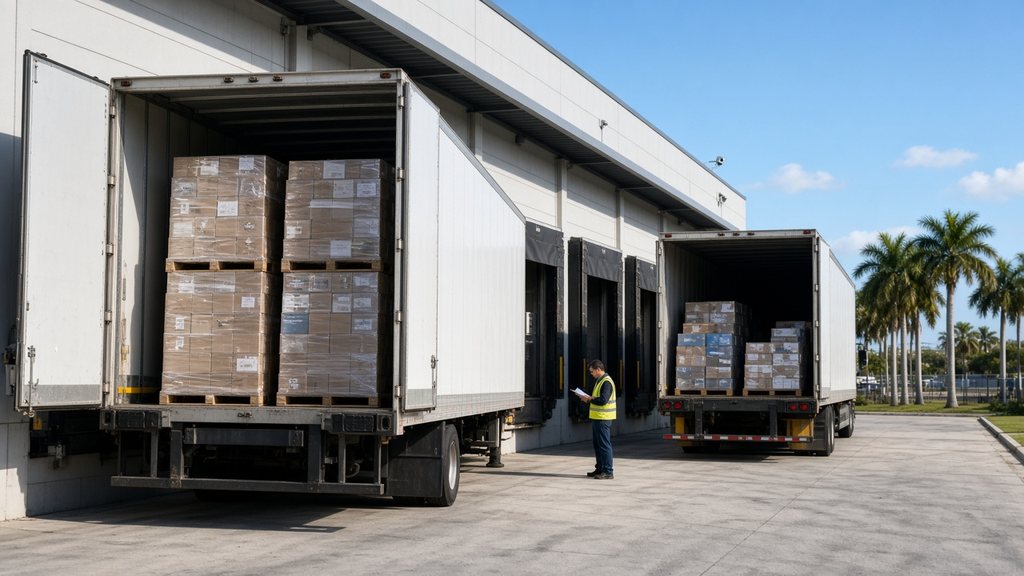
Two shipments of the same goods can arrive at a warehouse in very different ways. A less-than-truckload (LTL) shipment shares a trailer with other customers’ freight, passes through the carrier’s terminals and is delivered on the carrier’s route for the day. A full truckload (FTL) shipment has the trailer to itself and usually travels directly from the shipper to the receiving dock. That difference changes how you book the delivery, how precisely you can control the arrival time and what happens if the truck waits.
This guide is for shippers, importers and freight brokers sending palletised freight by road to a Miami-area warehouse for pallet storage, cross-docking or warehouse overflow. It explains how carriers draw the line between LTL and truckload, what to arrange for each type of delivery and how appointment times interact with driver hours and detention terms. Carrier rules quoted below are examples from published tariffs; your carrier’s terms may differ. It is general operational guidance, not legal or contractual advice.
The short answer
LTL suits smaller shipments, but the carrier controls the route and the arrival time unless you request (and usually pay for) an appointment. FTL gives you a dedicated trailer and a more predictable arrival, but you pay for the whole truck and the driver’s waiting time matters more. Between the two sits volume LTL or partial truckload, which is worth quoting once a shipment takes up a substantial part of a trailer. Whichever you choose, book the delivery with the warehouse before the truck is dispatched and give the carrier the reference the dock team expects.
LTL and FTL deliveries compared
| Factor | LTL delivery | Full truckload delivery |
|---|---|---|
| Trailer | Shared with other shipments; often a 28-foot “pup” or a shared trailer on a city route | Dedicated to your shipment |
| Route | Origin terminal, line-haul, destination terminal, then a delivery route with several stops | Usually direct from the shipper to the receiving dock |
| Arrival time | Set by the carrier’s route unless an appointment or notification is requested | Normally agreed in advance as a specific appointment |
| Tracking reference | Carrier PRO number plus the bill of lading | Load or trip number from the carrier or broker plus the bill of lading |
| Handling in transit | Pallets may be moved at terminals between trailers | Usually loaded once and unloaded once |
| Typical charges to watch | Freight class or density, appointment or notification charges, capacity-load rules | Detention after free time, late-arrival or rescheduling terms in the rate confirmation |
Where LTL ends and truckload begins
There is no single legal threshold. Each carrier sets its own rules, usually by weight and by the length of trailer floor the freight occupies (linear feet). For example, Old Dominion Freight Line’s rules tariff defines LTL as freight typically weighing less than 20,000 lb or occupying less than 20 linear feet of a trailer, and its “capacity load” item applies to shipments needing 20 linear feet or more, or weighing 20,000 lb or more. Saia’s online quote page asks for a spot quote when a shipment exceeds 10 standard pallet spaces or 16 feet of trailer.
You can estimate linear feet yourself. Standard 48 × 40 in pallets loaded two across a trailer, with the 48 in side running lengthways, use about 4 feet of floor for every pair. Ten pallets that cannot be stacked therefore need roughly 20 linear feet. Stacked pallets use less floor, but only if the carrier and the warehouse agree that they can be stacked safely.
LTL pricing also depends on freight classification. Since 19 July 2025, the National Motor Freight Classification has moved more than 2,000 items to density-based classification, according to the National Motor Freight Traffic Association (NMFTA). NMFTA advises shippers to record the dimensions of each handling unit on the bill of lading. Accurate pallet dimensions and weights help both the carrier’s quote and the warehouse’s planning; our inbound pallet receiving checklist covers pallet build, labels and paperwork in more detail.
Booking an LTL delivery
An LTL driver may have many stops on the route, so the arrival time depends on the stops before yours. If the warehouse needs the delivery inside a specific window, ask for that when you book the shipment, not when it is already on the delivery truck.
- Request the appointment through the carrier. Carriers generally treat “call before delivery” or “deliver by appointment” as an extra service. Old Dominion’s rules tariff, for example, lists a separate per-shipment charge for notification before delivery and another for scheduling an appointment. Check your own carrier’s accessorial list before writing instructions on the bill of lading.
- Send the PRO number to the warehouse. The PRO number is how the dock team and the carrier identify the shipment. Send it with your reference, pallet count and expected delivery date as soon as the shipment is picked up.
- Allow for terminal time. An LTL shipment may reach the destination terminal one day and go out for delivery the next. The pickup date plus the quoted transit time is an estimate, not an appointment.
- Do not ask for services the dock does not need. A liftgate is normally for addresses without a loading dock. A warehouse with dock doors usually does not need one, so confirm before adding it.
Booking a full truckload delivery
With a dedicated truck, the appointment is usually a fixed time agreed between the warehouse and the carrier or broker. Confirm it in writing and make sure the same time appears in the carrier’s rate confirmation, so the driver plans the trip around it.
- Agree whether the unload is live. In a live unload, the driver waits while the trailer is unloaded. Some warehouses also accept dropped trailers that are left on site and collected later. Do not assume either option: ask the warehouse what it accepts for your shipment before the load is booked.
- Share the load profile. Pallet count, whether any pallets are stacked, the heaviest pallet weight and any freight that must not be double-stacked all affect how long the unload takes and where the freight goes.
- Plan for the driver’s schedule. A truckload from another state may have travelled for a full driving shift. An early-morning appointment can be easier to meet than a late-afternoon one, because a delayed driver may run out of permitted hours before the dock reopens.
If the freight is arriving in an ocean container rather than a trailer, the planning is different again: see our container devanning planning guide and the comparison of floor-loaded and palletised containers.
Waiting time, detention and driver hours
Detention charges compensate carriers when a truck is held at a facility beyond an agreed free time. The rules sit in the carrier’s tariff or in the rate confirmation for a truckload, and they differ between carriers. Two details from Old Dominion’s rules tariff show why the appointment matters:
- When an appointment has been made, the carrier’s detention clock starts at the appointment time, not when the driver turns up early.
- Free time for a delivery vehicle is short and scales with the number of shipments delivered at that stop, starting at 20 minutes for a single shipment.
For truckload drivers, waiting also uses up legally limited working time. Under the Federal Motor Carrier Safety Administration (FMCSA) hours-of-service rules, a property-carrying driver may drive up to 11 hours after 10 consecutive hours off duty and may not drive beyond the 14th consecutive hour after coming on duty. Off-duty time does not extend that 14-hour window, so a long wait at a dock can end a driver’s day.
FMCSA research notes that a 2014 FMCSA study found drivers experienced detention on about 1 in every 10 stops, averaging 1.4 hours beyond a two-hour standard. Clear appointments, accurate pallet counts and a confirmed scope are the practical ways a shipper can reduce that risk.
Fitting deliveries into receiving hours
3PL Prime in Medley receives freight Monday to Friday, 8:00 AM–4:00 PM, and is closed at weekends. Book appointments so that the unload can be completed inside those hours. For a full truckload, an appointment at the very end of the day leaves little room for traffic or a late arrival. For LTL, a delivery that misses Friday’s route will usually wait until the following week.
If the truck is running late, the carrier should call ahead so the appointment can be moved rather than the driver arriving after closing. Agree who will handle that call: the shipper, the broker or the carrier’s dispatcher.
Hypothetical example: 14 pallets, three ways
Hypothetical example with invented figures, not a customer case. A distributor in Georgia needs to send 14 non-stackable pallets of packaged goods, each 48 × 40 in and about 900 lb, to a Medley warehouse for storage.
- Standard LTL quote: 14 pallets loaded two across need about 28 linear feet, and the shipment weighs about 12,600 lb. That is beyond both carrier thresholds quoted above, so a standard class-based quote may be replaced by a capacity-load charge or a spot quote.
- Volume LTL or partial truckload: the distributor asks for a volume quote, giving exact pallet dimensions, weights and the non-stackable status. The freight still moves through the carrier’s network, so the distributor also requests a delivery appointment and sends the PRO number to the warehouse.
- Full truckload: the distributor compares the cost of a dedicated trailer. It would travel directly with a fixed appointment, and the space left in the trailer could carry more stock if the distributor wants to move more pallets at once.
Whichever option wins on price, the warehouse needs the same things: the pallet count, dimensions, weights, the carrier and reference number, and an appointment inside receiving hours. When the freight later leaves by carrier, the outbound freight pickup checklist covers the other side of the dock.
An appointment request you can copy
- Your company name and reference or PO number:
- Delivery type: LTL / volume LTL / full truckload (live unload or drop trailer, if agreed):
- Carrier name and PRO, load or trip number:
- Requested date and time (Monday–Friday, 8:00 AM–4:00 PM):
- Pallet count, dimensions and weight per pallet; stackable or not:
- Commodity and any hazardous material status:
- After unloading: store, cross-dock or stage for onward dispatch:
- Contact for delays, exceptions and photographs:
3PL Prime operates from Medley with 9 dock doors, 1,500 racked pallet positions and additional floor storage. Inbound deliveries are booked by appointment for pallet storage, cross-docking, freight staging and overflow storage, and unload ocean containers through our container devanning service. Receiving hours are Monday to Friday, 8:00 AM–4:00 PM; we are closed at weekends. Send us the shipment details and we will confirm whether we can accept the freight, the scope and an appointment before you dispatch.
Sources
- Federal Motor Carrier Safety Administration, Summary of Hours of Service Regulations.
- eCFR, 49 CFR 395.3: Maximum driving time for property-carrying vehicles.
- Federal Motor Carrier Safety Administration, Impact of Driver Detention Time on Safety and Operations (last updated 3 October 2025).
- Old Dominion Freight Line, Rules Tariff ODFL 100-Q (definition of LTL; Item 502, detention; Item 647, notification or appointment).
- Old Dominion Freight Line, Accessorial services brochure (based on tariff ODFL 100-Q effective 5 October 2026; Item 390, capacity load).
- Saia, LTL quote page (spot-quote guidance for shipments over 10 pallet spaces or 16 feet).
- NMFTA, How shippers can prepare for the 2025 NMFC changes and shipper checklist.