
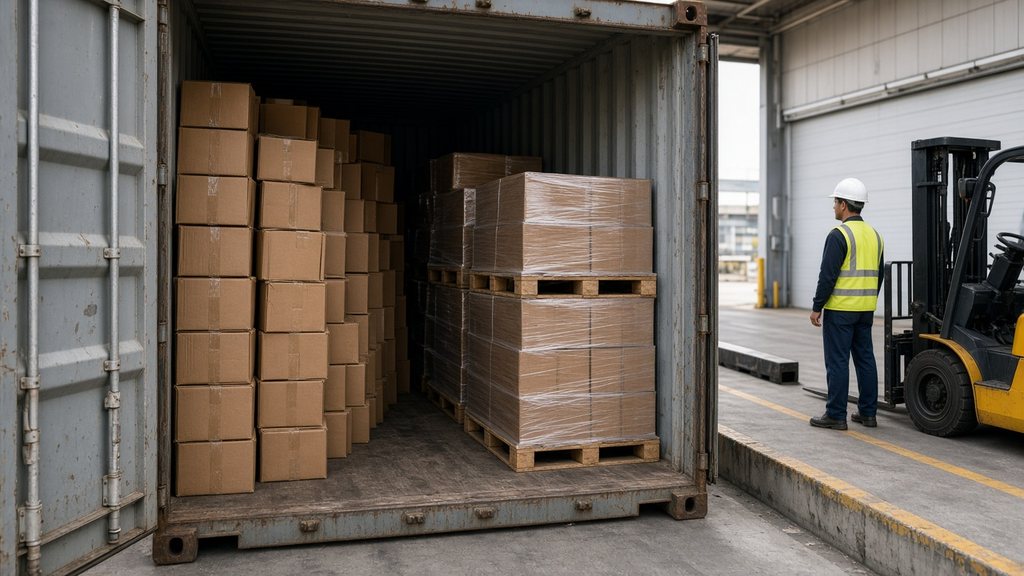
Before a supplier loads an export container, someone has to decide whether the cartons go in loose, stacked from floor to ceiling, or built onto pallets first. The choice is usually made at origin, often by default, but its consequences arrive at the Miami warehouse door: how long the container takes to unload, how much handling the cargo receives, whether the freight can go straight into racking and whether the wooden pallets themselves raise an import problem.
This guide is for importers, freight forwarders and customs brokers bringing containers through PortMiami or other Florida ports to a Miami-area warehouse for container devanning, transloading or pallet storage. It draws on the IMO/ILO/UNECE Code of Practice for Packing of Cargo Transport Units (the CTU Code), USDA APHIS and CBP guidance on wood packaging, and NIOSH guidance on manual lifting. It is general operational guidance, not legal, customs or engineering advice. In US shipping documents you will usually see the spelling “palletized”.
The short answer
Floor-loading usually fits more cartons into the container but moves the work to the destination, where every carton is handled by hand. Palletising uses some of the container’s space and payload for pallets but allows a forklift unload and faster receiving. The right choice depends on carton weight and fragility, how much cube you would lose, what happens to the goods after unloading and whether your supplier can provide compliant pallets of the right size.
Floor-loaded and palletised compared
| Factor | Floor-loaded (loose cartons) | Palletised |
|---|---|---|
| Container space | Cartons can fill the floor and most of the height | Pallet footprints rarely fill the floor exactly, and the pallet itself takes height |
| Work at origin | Cartons stacked by hand into the container | Pallets built, wrapped and loaded by forklift |
| Work at destination | Hand unloading, sorting and palletising before storage | Forklift unloading; pallets may go straight to storage if they suit the racking |
| Handling risk | Many individual lifts; heavy cartons add manual-handling risk | Fewer touches per carton; pallets need sound wrapping and securing |
| Import paperwork | No pallets, so no pallet wood to inspect (other wood dunnage still counts) | Solid-wood pallets must meet ISPM 15 |
| Counting on arrival | Cartons counted as they come off; mixed SKUs need sorting | Pallets counted quickly; cartons inside counted only if the scope includes it |
How much container space pallets cost you
A standard 40-foot container is roughly 12.03 m long and 2.35 m wide inside; a 40-foot high cube has the same floor but about 2.69 m of internal height instead of about 2.39 m. iContainers, a freight forwarder, puts the single-tier capacity of a 40-foot container at up to 21 North American 48 × 40 in (1,219 × 1,016 mm) pallets, or about 10 in a 20-foot container, depending on the loading pattern. Pallets cannot fill the floor completely, because the 48 × 40 in footprint does not divide evenly into the container’s width.
Height is the second loss. Every pallet adds its own deck height to each stack, and a high cube only adds pallet positions if the pallets can be safely double-stacked. iContainers notes that a high cube does not usually provide more single-tier floor positions and that double-stacking should never be assumed: the lower pallets must carry the weight, the load must be secured and the payload must not be exceeded.
So ask your supplier or forwarder for a loading plan for both methods, using your real carton dimensions, rather than relying on a rule of thumb. The difference can be small for cartons that build neatly onto a 48 × 40 in footprint and large for awkward sizes.
What changes at the warehouse door
Floor-loaded containers are unloaded by hand. Each carton is lifted, often from above shoulder height or near the floor, then sorted and built onto pallets before it can be stored or shipped. That is normal devanning work, but it takes longer than driving pallets out with a forklift, and the time grows with the carton count and the number of SKUs to separate.
Carton weight matters. OSHA has no standard that sets a maximum weight a person may lift; it points employers to the Revised NIOSH Lifting Equation. That equation starts from a load constant of 51 lb (23 kg), the weight nearly all healthy workers could lift under ideal conditions, and then reduces it for reaching, twisting, lifting from low or high positions, frequency and poor grip. Unloading a container is rarely ideal, so heavy cartons are a strong argument for palletising or for telling the warehouse in advance so it can plan the work.
Palletised containers can be unloaded by forklift, provided the pallets are sound, the loads are stable and the pallets were loaded so that they can be reached. If the pallets will go into racking, their size, condition and loaded height also need to suit the warehouse’s racking; otherwise the freight may have to be restacked onto new pallets, which removes much of the benefit. Confirm what the receiving warehouse accepts before your supplier builds the pallets.
Securing the load for the voyage
Both methods have to survive the sea voyage and the drive from the port. The CTU Code asks packers to plan either a tight stow, with packages filling the space between the walls, or a secured stow, where cargo that does not fill the space is held by blocking or lashing. It says the sum of void spaces in any horizontal direction should not exceed 15 cm, and it notes that gaps between pallets need not be filled if the pallets are stowed tightly, the cargo is firmly secured to them and they are not liable to tip. It also warns that shrink wrap is only sufficient if it is strong enough, because repeated heavy loads in bad weather can fatigue it.
The Code also asks packers to consider the people who will unpack the container and to avoid any possibility of cargo falling out when the doors are opened. With a floor-loaded container stacked to the roof, ask your supplier how the last rows near the doors will be held. Our guide to container seal checks before unloading covers what to expect when the doors are first opened.
Moisture is a smaller but real point. The CTU Code’s guidance on condensation lists timber bracing and pallets among the sources of humidity inside a closed container, so wet or green pallet timber should not be used for moisture-sensitive goods.
Wooden pallets on imports: ISPM 15
If your goods arrive on solid-wood pallets, those pallets are regulated wood packaging material. APHIS requires wood packaging entering or transiting the United States to be debarked, treated (heat-treated or fumigated) and marked with the ISPM 15 mark, and says shipments with non-compliant wood packaging will not be allowed to enter. The mark includes the IPPC logo, a two-letter country code, the treatment facility’s number and the treatment code. From 1 January 2026, APHIS and CBP resumed enforcing the hyphen between the country code and the producer code, after a temporary suspension during 2025.
Floor-loading avoids pallet timber, but not every wood risk: CBP’s definition also covers dunnage, bracing and other wood used to support or protect cargo. APHIS lists alternatives that it does not regulate, including plastic pallets, plywood and pressboard. Put ISPM 15 compliance in your purchase terms and ask the supplier to confirm it before loading.
Weight and payload
Pallets add weight as well as height. The CTU Code says the mass of the planned cargo should not exceed the container’s maximum payload, and the permitted gross mass is marked on the container’s safety approval plate. For heavy, dense goods the limiting factor may be weight, not space, in which case palletising may cost you little cube at all. For light goods that fill a container long before it reaches its weight limit, the space lost to pallets matters more.
Which method suits which shipment
| Floor-loading often makes sense when… | Palletising often makes sense when… |
|---|---|
| Cartons are light, robust and uniform | Cartons are heavy, fragile or awkward to grip |
| Lost cube would mean booking an extra container | The cargo reaches the weight limit before the space limit |
| Freight will be sorted by SKU, order or destination after unloading anyway | Pallets can go straight into storage or onward trucks without rework |
| The supplier cannot provide compliant pallets of a suitable size | The receiver needs fast turnaround, for example a tight container return deadline |
A mixed load is also possible: heavy or fragile lines on pallets, light cartons floor-loaded around them. Tell the warehouse it is mixed, with separate counts, so the unloading plan covers both.
Hypothetical example: one product, two loading plans
This example is invented to show the trade-off. It uses simple geometry and ignores packing tolerances, so treat the numbers as illustrative only.
An importer ships cartons measuring 50 × 40 × 30 cm in a 40-foot high cube (internal space taken as 12.03 × 2.35 × 2.69 m).
- Floor-loaded: with the best orientation, the geometry allows roughly 1,000 cartons, a little fewer in practice.
- Palletised: six cartons per layer on a 48 × 40 in pallet. Assuming a 15 cm pallet, cartons strong enough to be double-stacked and pallets kept to a stable, forkliftable height, two tiers of three layers each (about 1.05 m per pallet) fit under the roof. With 21 floor positions, that is 42 pallets of 18 cartons, or 756 cartons.
Palletising carries about a quarter fewer cartons here. If the importer needs 1,500 cartons, that could be two floor-loaded containers or two palletised ones, and palletising costs little extra space. If the importer needs 1,000, floor-loading may avoid a second container but means every carton is unloaded by hand. Now change one assumption: if each carton weighed 28 kg, above the NIOSH load constant before any reduction for real conditions, the case for pallets becomes much stronger regardless of cube.
What to agree with your supplier and warehouse
- Loading method: floor-loaded, palletised or mixed, with the count of cartons and pallets for each part
- Carton dimensions and weights, and the heaviest carton in the load
- Pallet size, material, loaded height and whether pallets are stacked two high
- ISPM 15 marks on all solid-wood pallets and dunnage, or a non-regulated alternative
- How the load is secured, especially the rows nearest the doors
- A loading photo of the door end before the container is sealed
- Required output at the warehouse: pallets by SKU, purchase order or destination, and the finished pallet specification
- What happens after unloading: storage, cross-dock or onward truck
3PL Prime operates from Medley with 9 dock doors, 1,500 racked pallet positions and additional floor storage. Floor-loaded containers are a core part of our devanning work: we unload by hand, sort, palletise and stage freight for storage or onward dispatch according to the agreed scope. Receiving hours are Monday to Friday, 8:00 AM–4:00 PM; we are closed at weekends. For planning the unloading itself, see our container devanning planning guide and the inbound pallet receiving checklist. For what happens next, see pallet storage, warehouse overflow when a primary site is full, cross-docking and 3PL for importers. Then send us the container details and we will confirm whether we can accept the load, the scope and an appointment before you dispatch.
Sources
- IMO/ILO/UNECE, Code of Practice for Packing of Cargo Transport Units (CTU Code), Annex 7 (paragraphs 1.2, 1.7, 1.8, 2.3.6 and 2.3.7) and Annex 3 (condensation).
- USDA APHIS, Import ISPM 15-compliant wood packaging material into the U.S.
- USDA APHIS, Suspension of ISPM 15 hyphen requirement ends December 31, 2025.
- U.S. Customs and Border Protection, Wood packaging materials.
- NIOSH, Applications Manual for the Revised NIOSH Lifting Equation (Publication 94-110, revised 2021).
- OSHA, Standard interpretation: procedures for safe weight limits when manually lifting (4 June 2013).
- iContainers, How many pallets fit in a 20-ft and 40-ft container (updated 16 October 2026).