
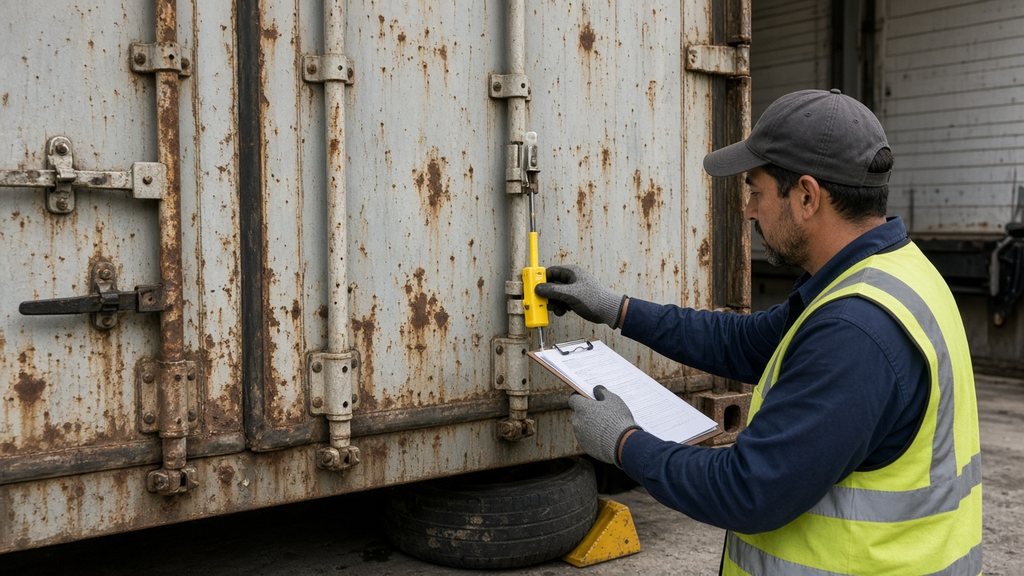
When an import container reaches a warehouse door, the first few minutes decide how much evidence you will have if something later turns out to be wrong. Once the seal has been cut and the doors opened, nobody can go back and check whether the seal number matched the bill of lading or whether the doors had been tampered with.
This guide is for importers, customs brokers and freight forwarders sending containers to a Miami-area warehouse for container devanning or transloading. It explains what to send before the container arrives and which checks to expect at the door. It draws on U.S. Customs and Border Protection (CBP) CTPAT security criteria, the IMO/ILO/UNECE Code of Practice for Packing of Cargo Transport Units (the CTU Code) and OSHA rules for powered industrial trucks. It is general operational guidance, not legal, customs or security-programme advice.
Send the container and seal numbers before the truck leaves
A seal check is only as good as the number it is checked against. CBP's CTPAT Minimum Security Criteria for U.S. importers state that seal numbers assigned to shipments should be sent to the consignee before departure (criterion 7.29) and should be printed electronically on the bill of lading or other shipping documents (7.30). Even if your business is not a CTPAT member, the same habit gives the receiving warehouse something firm to compare.
Send the receiving warehouse, before the drayage truck is dispatched:
- the container number exactly as shown on the bill of lading or delivery order;
- the seal number or numbers shown on the shipping documents;
- your reference, the packing list and the expected carton or pallet count;
- the trucking company and the requested appointment; and
- who to call if the container or seal does not match, and who decides what happens next.
Customs release, terminal pickup and equipment return are separate questions from the seal check. Our container devanning planning guide covers those steps.
Check the container number first
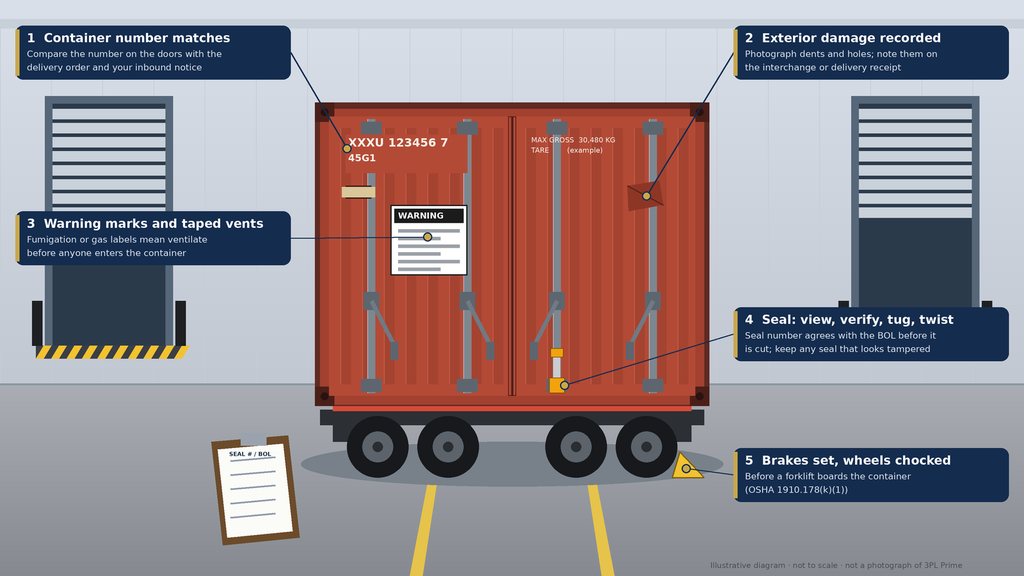
The CTU Code's annex on receiving cargo transport units (IMO-published CTU Code, Annex 5, paragraph 1.2.1) advises the receiver to confirm that the unit matches the transport documents by checking its identification reference. If the number on the container differs from the documents, the Code says the unit should not be accepted until the shipper has clarified the discrepancy.
A single wrong digit in an email is usually a typing error, but it should be resolved before the seal is cut, not afterwards. This is why it helps to copy the number from the bill of lading or delivery order rather than retyping it.
Check the seal: view, verify, tug, twist
CTPAT criterion 6.7 sets out a four-step seal verification process known as VVTT. CBP's recommended seal procedures say that, at the point of receipt, importers and consolidators must use VVTT, with a witness, before cutting the seal on an inbound shipment. CBP notes that some items in that document go beyond the minimum criteria.
| Step | What is checked | What to record |
|---|---|---|
| View | The seal and the container locking mechanism: handles, locking bars, hinges and door hardware | Photographs of the seal and door hardware before cutting |
| Verify | The seal number against the shipping documents | The number read from the seal and the document it was compared with |
| Tug | That the seal is properly attached and does not pull free | Pass or fail |
| Twist | That the parts of a bolt seal do not unscrew or separate; a cable seal should be taut with no slippage | Pass or fail, and who witnessed the check |
CTPAT criterion 6.2 says high-security seals on CTPAT shipments must meet the current ISO 17712 standard and should be placed on the secure cam position where one is available, otherwise on the centre-most left-hand locking handle of the right-hand door. Knowing where the seal is expected to be makes it easier to notice when something looks wrong.
If the seal is different, damaged or missing
A different seal number does not automatically mean tampering. CBP's criteria note that goods may be examined in transit by a foreign customs authority or by CBP. When the government breaks a seal for an examination, a new seal is applied and its number needs to be recorded; in some cases the record may be handwritten (implementation guidance to criterion 7.8). Your customs broker can usually confirm whether the container was examined.
Until the explanation is confirmed, the CTU Code (Annex 5, paragraph 1.2.3) and CTPAT criterion 6.1 point to the same basic steps:
- Do not cut the seal yet. Photograph the seal, its number and the door hardware.
- Tell the carrier and the shipper or importer, and note the discrepancy on the delivery paperwork.
- Keep any seal that appears altered or tampered with once it is removed, as CTPAT asks members to retain such seals to aid investigations.
- Follow the importer's reporting procedure. CTPAT members are expected to report compromised seals to CBP as applicable; the CTU Code refers to notifying customs or law enforcement in line with national legislation.
Who decides?
The warehouse can record what it saw and stop before cutting the seal. Whether the container is accepted, examined further or reported is usually a decision for the importer, its customs broker and the carrier. Agree in advance who will make that decision and how quickly they can be reached during receiving hours.
Look for warning marks before the doors open
After the seal has been removed, the CTU Code (Annex 5, section 4) advises checking the outside of the container for labels or marks indicating that opening it could put people at risk. Containers that have been fumigated, or that carry a coolant or conditioner, should be opened and ventilated before anyone enters.
The Code adds two cautions that matter for importers:
- fumigation marks can be lost in transit, so tape over door gaskets or air vents may indicate that fumigant is present; and
- the absence of a mark does not prove that no fumigant is present. Annex 9 notes that gas absorbed by cargo can be released over many days, even after a container has been ventilated.
The Code lists foodstuffs, leather goods, handicrafts, textiles, timber or cane furniture, and cargo in timber cases or on timber pallets among the cargoes most likely to have been fumigated. If you know or suspect that a container has been fumigated, or it contains dangerous goods, say so before booking so that acceptance, ventilation and handling can be agreed before the truck is dispatched. The Code also says a safety data sheet should be requested where there are concerns about a dangerous atmosphere.
Open the doors as if the load has shifted
Cargo can move at sea and rest against the doors. The CTU Code (Annex 5, section 6) suggests "ringing" steel doors by tapping them: a dull sound with no resonance suggests that cargo is resting against them. Where that is a risk, a safety chain or strap can limit how far the doors open, to no more than about 150 mm (6 in), until it is clear that nothing will fall out.
Before a forklift drives into the container, OSHA 29 CFR 1910.178 requires the brakes of highway trucks to be set and wheel chocks placed under the rear wheels (paragraph (k)(1)). Paragraph (m)(7) also requires the flooring of trucks and trailers to be checked for breaks and weakness before they are driven onto. These are the warehouse's responsibilities, but they explain why a door check is not instant.
Record exterior damage on arrival
Look at the doors, panels and roof edges before unloading. According to the CTU Code (Annex 5, paragraph 8.4.3), the consignee will generally be held responsible for damage other than damage that has been verifiably observed and endorsed by the container operator, and for unaccompanied containers that endorsement should be shown on the interchange document. Damage that happened earlier in the journey can go unreported unless it is noted.
Ask for dated photographs of any dents, holes or door damage, and make sure they are noted on the interchange or delivery paperwork before the empty container leaves. Inside, damaged cartons should be photographed in place before they are moved. Our inbound receiving checklist explains why a note on a delivery receipt is evidence but not, on its own, a freight claim.
Hypothetical example: two containers, two outcomes
Hypothetical example, not a customer case. An importer books two 40-foot containers of furniture for unloading at a Medley warehouse on the same morning.
- Container A: the seal number on the door differs from the number in the pre-arrival email. The seal is not cut. The receiving team photographs the seal and contacts the importer, whose customs broker confirms that the container was examined and a replacement seal applied. The replacement number is recorded, and unloading proceeds once the importer confirms.
- Container B: the seal number matches, but the bolt turns freely when twisted and one locking handle looks bent. The seal is not cut. Photographs go to the importer and the carrier, the discrepancy is noted on the paperwork, and the importer decides, with its broker, what to do before the doors are opened.
The details are invented to show the decision points. They do not describe how long any check or delay will take.
A pre-arrival message you can copy
- Your company name and reference or PO:
- Container number (copied from the bill of lading or delivery order):
- Seal number(s) on the shipping documents:
- Container size; floor-loaded or palletised (see floor-loaded vs palletised containers); expected carton or pallet count:
- Fumigated, treated or dangerous goods: yes / no / unknown (attach any certificate or safety data sheet):
- Trucking company and requested appointment (Monday to Friday, 8:00 AM–4:00 PM):
- Has the broker reported a customs examination? yes / no / unknown:
- Contact for seal or container discrepancies, and who authorises unloading:
- Photographs required: seal, doors, cargo face on opening, damage:
- After unloading: pallet storage, cross-dock or transload, with outbound details if known:
3PL Prime operates from Medley with 9 dock doors, 1,500 racked pallet positions and additional floor storage. Receiving hours are Monday to Friday, 8:00 AM–4:00 PM; we are closed at weekends. If you are planning an import container, see our container devanning, transloading and 3PL for importers pages, or pallet storage, warehouse overflow when a primary site is full, and cross-docking for what happens after unloading. Then send us the container details, and we will confirm acceptance, scope and an appointment before you dispatch.
Sources
- U.S. Customs and Border Protection, CTPAT Minimum Security Criteria – U.S. Importers (October 2021), criteria 6.1, 6.2, 6.7, 7.8, 7.29 and 7.30.
- U.S. Customs and Border Protection, Seal Procedures, including best practices.
- U.S. Customs and Border Protection, CTPAT programme overview.
- IMO/ILO/UNECE, Code of Practice for Packing of Cargo Transport Units (CTU Code), Annex 5 (Receiving CTUs) and Annex 9 (Fumigation).
- OSHA, 29 CFR 1910.178, Powered industrial trucks, paragraphs (k)(1) and (m)(7).