
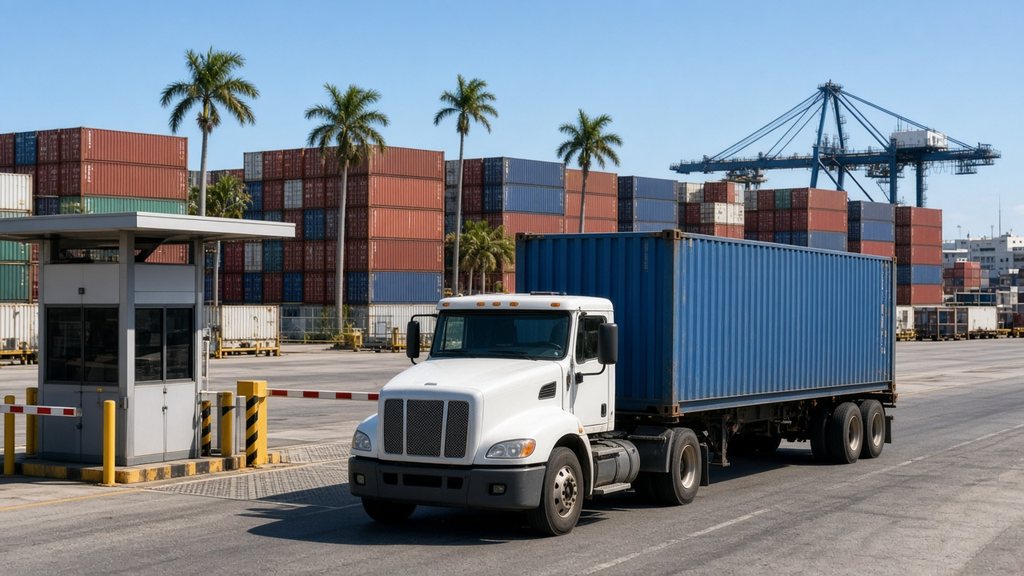
Importers often meet the words demurrage and detention for the first time on an invoice. The terms sound alike, the charges can accrue every day, and the rules about when they start and who sends the bill are not obvious. Unloading the container promptly is one of the few parts of the clock that an importer and its warehouse can control.
This guide is for importers, customs brokers and freight forwarders bringing containers through PortMiami or other South Florida ports to a Medley warehouse. It explains what the two charges are, how free time works, what the Federal Maritime Commission (FMC) requires on invoices, how to dispute a charge, and how to plan container devanning, transloading or cross-docking so that empty containers go back in time. It is general information, not legal advice: your bill of lading, the carrier’s or terminal’s published terms and a maritime lawyer are the authorities for your own case. For the practical side of unloading itself, read our container devanning guide.
The short answer
Demurrage is generally a charge for a container staying in the terminal after free time ends; detention is generally a charge for keeping the container outside the terminal beyond free time. Both are billed by the ocean carrier, terminal operator or an intermediary, not by your warehouse. Read the free time, start date and end date on the invoice, and check them against the container availability date. Federal rules set minimum invoice contents and time limits, and a billed party can ask for mitigation, refund or waiver within the period the invoice states, which must be at least 30 calendar days. To reduce the risk, line up the delivery, the unloading appointment and the empty return before the container leaves the terminal.
Demurrage and detention: what each means
The FMC’s billing rule defines both terms together: demurrage or detention means any charges, including “per diem” charges, assessed by ocean common carriers, marine terminal operators or non-vessel-operating common carriers (NVOCCs) related to the use of marine terminal space or shipping containers, not including freight charges. In everyday trade usage the two are separated as follows.
| Demurrage | Detention | |
|---|---|---|
| Usually relates to | The container, or the space it occupies, inside the marine terminal | The container, and sometimes the chassis, outside the terminal |
| Clock typically stops when | The container is picked up and leaves the terminal | The empty container is returned as the carrier requires |
| Where the rule is written | Terminal tariff and carrier terms | Carrier tariff, service contract or bill of lading terms |
| Your levers | Pick-up appointment timing, release status, paperwork | Unloading speed, empty return appointment, driver and chassis plan |
Terminology is not uniform. Some carriers combine the two into a single “per diem” or use their own names, so treat the table as a guide and read the definitions in the terms that apply to your shipment. The FMC’s interpretive rule on reasonableness, 46 CFR 545.5, says the Commission may consider how clearly regulated companies define these terms and how accessible the definitions are. Trucking charges, such as driver waiting time or chassis rental, are separate again; see the note in our LTL vs FTL guide on truck detention.
Who bills, and who pays
Under the FMC rule, the billing party is the ocean carrier, marine terminal operator or NVOCC that issues the invoice, and the billed party is the person who receives it and is responsible for payment. The rule also requires the invoice to state the basis on which the billed party is liable. In practice the importer, consignee, beneficial cargo owner or a customs broker or forwarder acting for them may be billed, depending on the bill of lading and the contract. If your forwarder is an NVOCC, you may receive the invoice from the forwarder and not from the shipping line.
Two points follow. First, check who the invoice says is responsible and why. If an incorrect person is invoiced, the rule says the billing party may re-invoice the correct party only within 30 calendar days of the date the charge was last incurred. Second, your warehouse, 3PL or trucker is normally not the billing party for these ocean charges, so it cannot waive them. What it can do is share unloading and return timestamps, which are useful evidence.
How free time runs
Free time is the period before charges start. Its length, its start point and whether weekends and holidays count are set by the terminal’s or carrier’s published terms and can differ by carrier, container type and cargo, so do not rely on a rule of thumb. Look for these items:
- The start event. For import demurrage, free time often starts when the container is available for pick-up, not simply when the ship arrives. The FMC requires the invoice to show the container availability date for imports.
- Business days or calendar days. One Miami terminal operator’s published FAQ, for example, says weekends and holidays are not counted against free time while it runs, but are counted as storage days once free time has expired. Another terminal or carrier may do it differently, so check the terms that apply to your container.
- Holds and inspections. A customs, freight or carrier hold can leave a container unavailable even though it is on the terminal. The FMC’s interpretive rule says it may consider how closely demurrage relates to cargo availability, whether notice of availability was given and how government inspections affected the charge. Keep records of when a hold was placed and lifted.
- Empty return. The same rule says that, absent extenuating circumstances, detention charged when an empty container cannot be returned is likely to be found unreasonable. Record any refused return appointment, closed gate or full yard.
- Extensions. Terms may allow free time to be extended or charges waived when the terminal could not release the container. Ask; do not assume.
What a compliant invoice must show
Since 28 May 2024, the FMC’s content requirements for demurrage and detention invoices in 46 CFR Part 541 have applied to ocean carriers, marine terminal operators and NVOCCs. At a minimum an invoice must be accurate and include:
- Identifying information: bill of lading number(s), container number(s), for imports the port(s) of discharge, and the basis on which the billed party is liable.
- Timing information: invoice date and due date, the allowed free time in days, the start and end dates of free time, for imports the container availability date, and the specific dates for which charges were applied.
- Rate information: the total due, the tariff rule, terminal schedule, service contract section or other arrangement the daily rate is based on, and the specific rate or rates.
- Dispute information: a contact for questions or for requests for mitigation, refund or waiver, a web address or similar digital means explaining what documents are needed, and the time limits for requesting and for resolving.
- Certifications: statements that the charges comply with the FMC’s rules, including Part 541 and 46 CFR 545.5, and that the billing party’s own performance did not cause or contribute to the charges.
The rule also sets time limits. A billing party must issue the invoice within 30 calendar days of the date the charge was last incurred (an NVOCC within 30 calendar days of the invoice it received itself); otherwise the billed party is not required to pay. Failing to include any of the required minimum information also eliminates the billed party’s obligation to pay the charge. The billed party must be given at least 30 calendar days from the invoice date to request mitigation, refund or waiver, and the billing party must attempt to resolve a request within 30 calendar days or a later date both agree. These provisions come from the Ocean Shipping Reform Act of 2022, which also bars invoicing demurrage or detention without the required information (46 U.S.C. 41104). The FMC announced the effective date of the invoice-content requirements in a Federal Register notice.
How to dispute a charge
- Check the invoice first. Compare it with the list above. Missing required items, the wrong container or bill of lading, or an unexplained liability basis are all grounds to raise in writing.
- Build the timeline. Gather the bill of lading, the arrival notice, the container availability date, any hold release records, pick-up and return appointment confirmations or refusals, gate or yard-closure notices, and unloading timestamps from your warehouse.
- Act inside the window. The invoice must say how and by when to request mitigation, refund or waiver, and the period must be at least 30 calendar days from the invoice date. Put the request in writing to the contact on the invoice before the deadline, and keep the reply.
- Escalate if needed. Any person may send the FMC a charge complaint under 46 U.S.C. 41310 about charges that may not comply with the Shipping Act. The FMC’s guidance says the submission should identify the carrier, explain how the charge breaks the rules and attach invoices, bills of lading and proof of payment, and that for demurrage and detention the carrier carries the burden of proving the charge is reasonable. The FMC’s Office of Consumer Affairs and Dispute Resolution Services also offers free ombuds and mediation help.
Paying an invoice under protest or while a dispute is open is a decision for you and your adviser. We cannot advise on it.
Where devanning and transloading fit
The charge clock is mostly set outside the warehouse: the vessel schedule, the terminal’s release and availability status, appointment slots at the gate and the shipping line’s return rules. A warehouse cannot shorten any of those. Where the warehouse matters is the middle step, from the container arriving at the dock to the empty leaving. That step is under your control, and these three options handle it differently:
- Container devanning means unloading the container at the warehouse, with the cargo then palletised, stored or sent on. If a live unload is arranged, the driver waits, the container is emptied and the empty returns, which suits time-sensitive containers. A drop-and-hook arrangement leaves the container at the dock until it is unloaded. It can ease scheduling, but the container is still out of the terminal while it waits and detention terms may still apply. See our guide on floor-loaded vs palletised containers, because unloading time depends heavily on how the container was packed.
- Transloading moves freight from the ocean container into domestic trucks or trailers. It also ends the container’s journey early, but the transfer still has to be scheduled and the empty returned. Our transloading guide sets out the options.
- Cross-docking passes freight through with minimal storage when the outbound carrier is already arranged. It works when the next movement is confirmed; see same-day cross-docking in Miami for its limits.
Whichever you choose, nothing here avoids a charge by itself. Faster unloading helps only if the container was available when expected, the pick-up and return appointments exist, and the warehouse has the space and labour ready. If you are not sure there will be room for the cargo, arrange pallet storage or warehouse overflow space before the container is dispatched, so the unload is not delayed. Our guide on container seal checks before unloading covers what happens at the door.
A planning checklist
| Step | What to confirm | Why it matters for free time |
|---|---|---|
| Before arrival | Free time terms, start rule and weekend treatment from the carrier and terminal; who will be billed | You know the dates that matter before the clock starts |
| Release | Customs, carrier and any other holds cleared; availability date confirmed | A container on the terminal is not always available |
| Transport | Drayage booked, with pick-up appointment and the delivery slot at the warehouse agreed together | A gap between pick-up and unloading lengthens the time outside the terminal |
| Warehouse | Unload appointment inside receiving hours, live unload or drop agreed, pallet specification, labour and space | Unloading starts when the container arrives, not the next day |
| Empty return | Return location, hours and appointment requirements, and who returns it | For detention, the clock usually runs until the return is accepted |
| Records | Arrival, unload start and finish, and release times from the dock; any refused appointments | Evidence supports any later request for mitigation, refund or waiver |
Hypothetical example: free time that ends on a Friday
This is a hypothetical example with invented dates and numbers, used only to show why weekend hours matter. It does not describe any real container, carrier, terminal or customer.
Without planning: an importer’s invoice shows that free time ends on Friday. The container is collected from the terminal on Friday afternoon and reaches the warehouse after the 4:00 PM close. The dock is closed at weekends, so the unload waits until Monday and the empty is returned later that day or on Tuesday. Whether any charge applies depends on the carrier’s terms, but the container has stayed out for the whole weekend after the end of free time.
With planning: the importer reads the free time end date a week earlier and books the pick-up for Wednesday, with a live unload at the warehouse on Wednesday morning and an empty return booked for the afternoon. The cargo is stored on pallets, and the empty is returned on Wednesday afternoon with a day or more of free time still in hand.
The dates are invented for illustration. They show how receiving hours and weekend closure can matter, not how long any particular unload takes.
Questions to ask before you book
- What are the free time rules for this container, and are weekends and holidays counted?
- On what date and at what time does the container become available for pick-up?
- Who will be billed for demurrage and detention, and on what basis?
- Where and when must the empty container be returned, and does that location need an appointment?
- Which warehouse days and hours can accept a live unload, and does the container need to arrive by a certain time?
- How will the cargo be palletised, labelled and stored, and is the space ready?
- Who will record the timestamps and share them quickly if an invoice is queried?
3PL Prime operates from Medley with 9 dock doors, 1,500 racked pallet positions and additional floor storage. We handle container devanning, cross-docking, freight staging and warehouse overflow for Miami-area importers. Our hours are Monday to Friday, 8:00 AM–4:00 PM; we are closed at weekends, so build that into any free-time plan. Send us your container details and we will confirm the scope and timing of the unload before you book the delivery. We do not issue demurrage or detention invoices and cannot give legal advice.
Sources
- eCFR, 46 CFR Part 541: Demurrage and Detention (definitions, invoice contents, issuance and dispute time limits).
- eCFR, 46 CFR 545.5: Interpretation of Shipping Act of 1984, unjust and unreasonable practices with respect to demurrage and detention.
- Federal Register, Demurrage and Detention Billing Requirements (14 May 2024; effective date 28 May 2024).
- Cornell Law School Legal Information Institute, 46 U.S.C. 41104: Common carriers (as amended by the Ocean Shipping Reform Act of 2022).
- Federal Maritime Commission, Guidance on Charge Complaints.
- Federal Maritime Commission, Consumer Affairs and Dispute Resolution Services.
- APM Terminals Miami, Frequently asked questions (first available date and free time; example of one terminal’s weekend treatment).